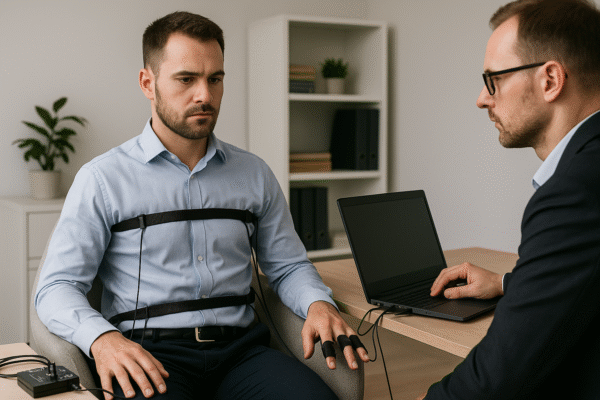
A polygraph is not a “mind-reading machine”. It is a sophisticated instrument that listens closely to the body: heart rhythm, breathing, blood pressure and micro-reactions that people usually do not control consciously. For many, the test feels like a psychological challenge: sensors, wires, the expert’s calm voice and the awareness that every answer comes with a physiological reaction.
In 2025, polygraph technology has become considerably more accurate. Digital analysis algorithms, artificial intelligence and new data-processing methods make it possible to assess a person’s reactions in greater depth. But the main thing has not changed: passing a polygraph successfully starts with understanding how it works and what exactly it measures. Knowledge takes away fear and replaces it with control.
Why people take polygraph tests and where they are actually used
The polygraph has long since moved beyond forensic science. Today it is widely used in business, corporate security, internal investigations and even in private conflicts.
In the commercial sector, the polygraph is used when selecting candidates for positions that demand a high level of trust: finance, security, logistics, access to confidential information. The rules differ from country to country: in the USA, private employers are mostly prohibited by law (the Employee Polygraph Protection Act of 1988) from using such tests, with exceptions for security firms and pharmaceutical companies, among others. In Ukraine, this practice is actively developing in the private sector.
In law enforcement, the polygraph is an auxiliary tool. It does not replace an investigation, but it helps to make sense of testimony, identify lines of inquiry or lift suspicion. It is important to understand that in Ukraine the result of an ordinary polygraph test is not evidence in court on its own. For court, a forensic examination is needed, and the court weighs its conclusion together with the other evidence.
Conflicts in families, in companies and between partners deserve a separate mention. When words can no longer be trusted, the polygraph becomes, for many, a way to restore clarity. But whatever the context, it is always a psychological strain in which the person’s inner state plays the decisive role.
Need a test rather than theory? Take the online VerifEye test — from 2,500 UAH (≈ €50), no office visit needed, or work out the cost of a polygraph test.
Preparing for a polygraph test: a professional step-by-step approach
Proper preparation starts not on the day of the test but well before it. A polygraph test is a process, not a surprise exam.
A standard test lasts 1.5 to 3 hours and consists of a preliminary interview, an explanation of the method and the testing itself. The modern systems used in 2025 record several physiological indicators at once, which makes the analysis more comprehensive.
Physical condition
A full night’s sleep is a must. Exhaustion reduces the body’s reactivity.
Alcohol, energy drinks and stimulants are off-limits for at least 24 hours before the test. Coffee is fine, but no later than 2–3 hours before the test.
Do not take any medication without consulting your doctor.
Psychological preparation
Understanding the procedure reduces anxiety.
It helps to picture the course of the test and your answers in advance.
Breathing techniques help to stabilise the pulse and blood pressure, but using them is prohibited.
Practical recommendations
Find out where the sensors will be placed so that nothing takes you by surprise.
Make sure there is written consent — without it the test is illegal!
If necessary, consult a psychologist or a polygraph examiner.
Preparation does not guarantee a “perfect chart”, but it greatly increases your chances of a calm test and an accurate result.
Need a test?
We’ll suggest which technology suits you best. We agree the questions in advance, and you get the result the same day. Confidential.
 Andriy Maryniak, polygraph examiner since 2012 · 6,000+ tests
Testing is done only with the voluntary written consent of the person being tested. Not sure which questions to ask? Ready-made test plans — from 590 UAH (≈ €12), credited towards the test.
Methods and techniques that actually work
One of the most common myths is that a polygraph can easily be “fooled”. In practice, crude countermeasures are almost always noticeable to an experienced specialist, especially given modern analysis algorithms.
The most effective strategy is control, not deception.
Techniques that work
Steady breathing: an even rhythm helps you avoid sharp physiological spikes.
Mental distance: take the questions calmly, without playing out emotional scenarios in your head.
Visualising calm images lowers your overall level of tension — but the examiner will see it.
Inner consistency: answer clearly and in the same way every time, without hesitation and without needless qualifications.
In 2025, analysis systems detect unnatural reactions with high accuracy, including deliberate muscle tensing and rhythmic manipulation. That is why calm honesty is always more effective than attempts at manipulation.
Legal and ethical aspects in Ukraine
Ukrainian law is clear: a polygraph test is only possible with voluntary written consent. No employer has the right to force anyone to take a test.
The result of an ordinary test is not evidence in court on its own and is used within in-house checks or internal investigations; for court, a forensic examination is needed.
Knowing your rights is a key element of psychological confidence during the test.
The most common mistakes during a polygraph test
😰 excessive anxiety and panic
🤥 attempts at deception or “clever” tricks
☕ taking stimulants before the test
🗣️ inconsistent or contradictory answers
🚫 ignoring the legal aspects
Avoiding these mistakes significantly reduces the risk of false results.
Current trends and the future of the polygraph
Today the polygraph is increasingly combined with other technologies — for example, eye-movement analysis (EyeDetect). Polygraph accuracy is 85–89% (American Polygraph Association meta-analysis, 2011), and debates about ethics and psychological pressure continue.
The future lies in comprehensive assessment methods in which the polygraph is part of a broader analytical approach. In Ukraine, the main emphasis is on voluntariness, transparency and the professionalism of specialists.
Conclusion
A polygraph test is not a fight against a machine. It is an interaction between a person, their mind and their physiology. When you understand the process, follow the rules and keep your inner balance, the test stops being a threat.
The best strategy is calm, awareness and sincerity.
In a world of sensors and algorithms, these remain your most reliable allies.
Ready to take the test? Find out how much a polygraph test costs in Lviv — current prices and an online cost calculator.
Find out for sure — faster than you think
A polygraph test in Lviv — from 3,000 UAH (≈ €59); an online VerifEye test with no visit — from 2,500 UAH (≈ €50). We agree the questions before the test, and you get the conclusion on the day of testing. In another city? We will help you choose a method or recommend a fellow polygraph examiner.
Or take the VerifEye online test — no office visit, from 2,500 UAH (≈ €50)
Special offer Close
Request a free consultation in 30 seconds!
