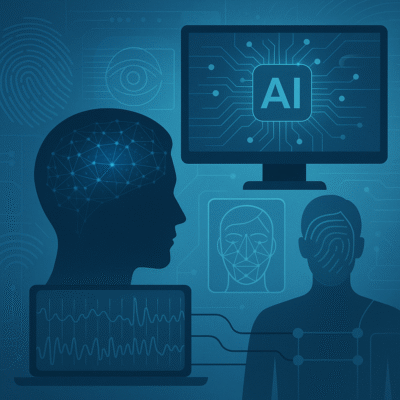
The polygraph has long ceased to be just a “lie detector”.
Today it is a complex system in which psychology, neuroscience and technology merge into a single whole.
The new generation of polygraphs uses artificial intelligence (AI) and biometric sensors, opening up an era of maximum accuracy.
How the classic polygraph works
A traditional polygraph records the body’s reactions: pulse, breathing, blood pressure and sweating.
The polygraph examiner analyses this data, drawing on experience and methodology.
The method is effective but depends on the human factor — the specialist’s emotional state and interpretation.
Need an actual test rather than theory? Take the VerifEye online test — from 2,500 UAH (≈ €50), with no need to visit an office — or calculate the cost of a polygraph test.
AI in polygraph testing — a new era of accuracy
Artificial intelligence has become the next stage in the polygraph’s development.
Machine learning algorithms can analyse thousands of signals at once, finding patterns that a human would not notice.
Advantages of AI polygraphs:
analysis is faster and more accurate;
the specialist’s subjective influence is minimised;
results are stored and checked automatically;
unified standards for assessing truthfulness are created.
AI systems are able to learn from large data sets, adapting to each person’s individual reactions. This makes it possible to achieve maximum objectivity.
Biometric technologies — a new level of analysis
Biometrics make it possible to record reactions without physical sensors.
Among the innovations:
recognition of facial micro-expressions;
eye movement analysis (EyeTracking);
reading the heart rate with infrared sensors;
voice and emotion analysis via video and audio.
Such solutions make testing contactless, comfortable and less stressful.
EyeDetect is an example of a system that analyses eye movements and detects deception with an accuracy of 86–90%.
Need a test?
We’ll suggest which technology suits you best. We agree the questions in advance, and you get the result the same day. Confidential.
 Andriy Maryniak, polygraph examiner since 2012 · 6,000+ tests
Testing is done only with the voluntary written consent of the person being tested. Not sure which questions to ask? Ready-made test plans — from 590 UAH (≈ €12), credited towards the test.
Virtual polygraphs and remote testing
Today, virtual polygraphs that use video analysis, AI algorithms and cloud data processing are already being tested.
This opens up the possibility of conducting tests online — for example, during recruitment or remote screening.
The human remains at the centre
Despite automation, the role of the polygraph examiner remains key.
The specialist of the future is an analyst who combines knowledge of psychology, technology and ethics.
It is the examiner who is responsible for accuracy, compliance with standards and the moral side of testing.
Update, October 2026: the Pentagon and Polygraph+
In September 2026 it became known that the US Department of Defense is asking for $30.3 million for Polygraph+ — a lie detector with AI-based scoring and contactless sensing. The budget has not been approved yet, and researchers are sceptical: there is no single sign of lying, so no system will be 100% accurate. What is planned, what the criticism is and what already exists today: The Pentagon wants $30 million for an AI lie detector.
What’s next?
Over the next 5–10 years, polygraph systems may be integrated with neural interfaces that read brain activity.
This will make it possible not only to see reactions but also to understand cognitive processes.
At the same time, ethical standards and personal data protection will become increasingly important.
✅ Conclusion
The future of the polygraph is a combination of AI, biometrics and human understanding.
Such systems make testing accurate, fast and humane, and — most importantly — they strengthen trust between people and companies.
Finding out for sure is quicker than you think
A polygraph test in Lviv — from 3,000 UAH (≈ €59); the VerifEye online test with no visit needed — from 2,500 UAH (≈ €50). We agree the questions before the test, and you get the conclusion on the day of testing. In another city? We will help you choose a method or recommend a fellow polygraph examiner.
Or take the VerifEye online test — no need to visit an office, from 2,500 UAH (≈ €50)
Special offer Close
Request a free consultation in 30 seconds!
